Teaching multiplication starts with equal groups and repeated addition: 3 groups of 2 make 6, so 3 × 2 = 6. Arrays, multiplication words and the commutative property come before memorizing facts.
Example: 3 groups of 4 = 4 + 4 + 4 = 3 × 4 = 12
Reviewed by the Helping with Math Team · Updated October 23, 2026
Related: For more on the first model, see multiplication as equal groups.
Related: For the next step after basic facts, see multiplying by multiples of 10.
On this page you will find information, suggested links, and other resources to help you to help your child with multiplication. These include (click or scroll for more):
- Multiplication Words“..times and stuff like that..“
- Learning Multiplication Facts
Discuss and explore with your child the concepts of grouping and repeated addition with your child, using real examples with objects that are in their everyday life.
While playing with and handling such objects be sure to introduce and use some of the words below.
Multiplication Words
- Groups of 3 groups of 2 make 6.
- Sets of 2 sets of 4 make 8.
- Lots of 2 lots of 2 make 4.
- Multiplied 3 multiplied by 4 is 12
- Product the product of 5 and 3 is 15.
- Times 3 times 2 is 6.
Don’t overlook the multiplication sign ( x ). Be sure your child knows what it means and doesn’t confuse it with other signs such as the addition ( + ) sign.
Before focusing on memorization and recall of multiplication facts you should encourage your children to develop their understanding of multiplication. Use the words above as you illustrate, explore and manipulate objects to show different representations of multiplication. Using these multiplication matching cards will help develop a good understanding of multiplication.
Try it: build a multiplication array
Set the rows and columns. Show the array as repeated addition, then turn it around to see that 3 × 5 and 5 × 3 give the same product.
Learning Multiplication Facts
By the end of 2nd Grade most children should have started to develop an understanding of multiplication through working with equal size groups of objects and through joining, or adding, these groups together. This repeated joining/ addition is one of the first multiplication strategies to be learned.
There are many different strategies and activities that can help with learning multiplication facts. Two of these are listed below:
- Check out Michele’s Multiplication Tips for some advice on helping your child to memorize multiplications facts
- Visit Susan Greenwald’s web site to read tips on how to help your child memorize multiplication facts
You can use these printable multiplication flashcards to practice memorizing basic multiplication facts and these multiplication games will also help.
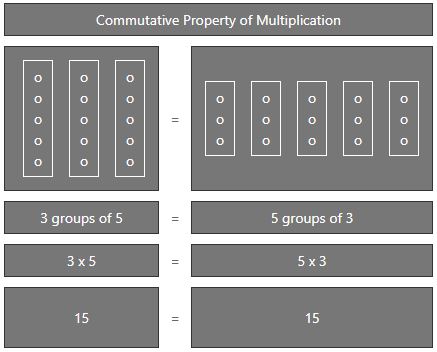
Commutative Property: a x b = b x a
Be sure your child knows that it does not matter the order in which two numbers are multiplied. For example, if he or she knows that 5 x 6 = 30, then he or she should know that 6 x 5 = 30. This will almost halve the number of facts that need to be memorized. Use objects to model this with your child. Use the illustration below as an example.
Try the worksheet below for more practice with basic multiplication facts
- Products to 81 e.g. 8 x 7
You’ll find more free multiplication worksheets and activities here.
Worked examples
Example 1
Equal groups. 4 bags each hold 5 apples. How many apples?
Solution
4 groups of 5 = 5 + 5 + 5 + 5 = 4 × 5 = 20.
Example 2
Turn the array. A child knows 6 × 7 = 42. What is 7 × 6?
Solution
Order does not matter, so 7 × 6 = 42.
Example 3
Use a known fact. Find 6 × 8 from 5 × 8 = 40.
Solution
6 × 8 is one more group of 8: 40 + 8 = 48.
Common mistakes
- Mistake: Reading 3 × 4 as 3 + 4. Fix: Say it in words: 3 groups of 4, which is 4 + 4 + 4 = 12.
- Mistake: Using groups of different sizes. Fix: Multiplication needs equal groups. Count that every group has the same number.
- Mistake: Memorizing 6 × 7 and 7 × 6 as two separate facts. Fix: Turn the array: one fact covers both, which nearly halves the list.
- Mistake: Skip counting by the wrong number. Fix: For 3 × 5, count by 5s three times: 5, 10, 15.
Practice generator
Every question is made at random. Get several right in a row to build your streak.
Type your answer and press Check.
Cheat sheet
| Idea | What to remember |
|---|---|
| Groups of | 3 groups of 2 make 6 |
| Repeated addition | 4 + 4 + 4 = 3 × 4 |
| Array | rows × columns |
| Commutative property | a × b = b × a |
| Product | the answer to a multiplication |
| Factors | the numbers being multiplied |
Quick quiz
Check yourself: teaching multiplication to your child
5 quick questions. Tap an answer to see if you are right.
3 groups of 5 is:
5 + 5 + 5.
Which equals 4 × 6?
Order does not matter.
2 + 2 + 2 + 2 + 2 =
Five groups of 2.
An array has 3 rows of 7. How many dots?
3 × 7.
The product of 5 and 3 is:
5 × 3.
Answered 0 of 5.
Teaching multiplication to your child FAQs
How do you teach multiplication to a child?
Begin with real objects in equal groups and show that adding the groups again and again is multiplication. Use words like groups of and times, then move to arrays and finally to learning facts.
What is the best way to learn multiplication facts?
Build understanding first, then practice a few facts at a time with flashcards, games and skip counting. Learn the 2s, 5s and 10s first, then use them to work out harder facts.
What does commutative property mean in multiplication?
It means the order of the factors does not change the product: 5 × 6 = 6 × 5 = 30. Turning an array a quarter turn shows why.
When should children learn multiplication?
Most children meet equal groups in 2nd grade and learn multiplication and the facts to 10 × 10 in 3rd grade.
Why do children confuse the multiplication and addition signs?
The × and + look alike. Have your child say the sign in words, such as “3 times 2” or “3 groups of 2”, before working out the answer.
Recommended Worksheets
More practice: Products to 81 e.g. 8 x 7, Printable Multiplication Flashcards and Multiplication Worksheets.


