Simultaneous equations are two equations with the same two unknowns, solved together. The solution is the pair (x, y) that makes both equations true, which is where their graphs cross. Solve by graphing, elimination or substitution.
Example: 4x − 2y = 10 and x + y = 4 give x = 3, y = 1
Reviewed by the Helping with Math Team · Updated October 23, 2026
Related: For graphing a single line, see linear equations.
Related: To draw each line quickly, see graphing lines in slope-intercept form.
Simultaneous equations are two equations, each with the same two unknowns and are “simultaneous” because they are solved together.
Worksheets
Click below for the Simultaneous Equations Worksheet Generator which provides limitless questions for practice.
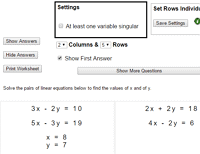
In simple terms, the solution to a pair of simultaneous equations is the x and y values of the coordinates of the point at which the graphs cross or intersect. The example below shows this.
Try it: find where two lines meet
Each slider sets one number in ax + by = c. Watch the crossing point move, and try the presets for parallel lines and for two equations that describe the same line.
Solving Graphically
For each equation, find coordinates for two points on the graph. An easy way of doing this is finding corresponding values when x = 0 and when y = 0. (Note: this will give 2 sets of coordinates which, since the equation is linear, is enough although it is a good idea to check at least one more point on the line.)
For 4x − 2y = 10 this gives (2.5, 0) and (0, −5) which we plot and then extend a straight line through.
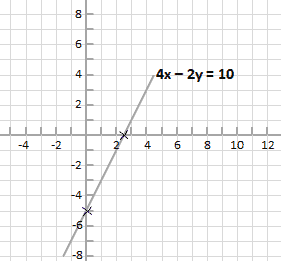
For x + y = 4 this gives (0,4) and (4,0) which we plot and then extend a straight line through.

Notice that all the coordinates through which the lines pass are solutions to each equation. And the coordinates of the point at which they cross, (3, 1) is the solution to the pair of simultaneous equations.
Solving Algebraically
We can find solutions to simultaneous equations algebraically too. There are two common methods. Which one you choose might depend on the values involved or it might just be the method you like the most. We will use the same pair of equations as above.
Elimination Method
| 4x − 2y = 10 x + y = 4 |
Multiply x + y = 4 by 2 to give 2x + 2y = 8 |
| 4x − 2y = 10 2x + 2y = 8 6x = 18 x = 3 |
We then add the two equations which “eliminates” the 2y (since −2y + 2y = 0) and leaves 6x = 18 which, after dividing both sides by 6 leaves x = 3 |
| 3 + y = 4 y = 1 |
We can then replace x in one of the equations with the value 3. (in this example, doing this in x + y = 4 is simpler than in 4x − 2y = 10) |
| 4x − 2y = 10 (4 x 3) − (2 x 1) = 10 12 − 2 = 10 |
It is always a good idea to check the values for x and y in the other equation.
Substitution Method
| 4x − 2y = 10 x + y = 4 |
Rearrange one equation to make either x or y subject of the equation. In this case it will be simpler to rearrange x + y = 4 which we can rearrange to y = 4 − x by subtracting x from each side |
| 4x − 2y = 10 4x − 2(4 − x) = 10 4x − 8 + 2x = 10 6x − 8 (+8) = 10 (+8) 6x = 18 x = 3 |
We then substitute 4 − x for y in the other equation. |
| 3 + y = 4 y = 1 |
As with the elimination method we then replace x in one of the equations with the value 3. (in this example, doing this in x + y = 4 is simpler than in 4x − 2y = 10) |
| 4x − 2y = 10 (4 x 3) − (2 x 1) = 10 12 − 2 = 10 |
And, as a check, try the values for x and y in the other equation.
More Examples Using Algebraic Methods
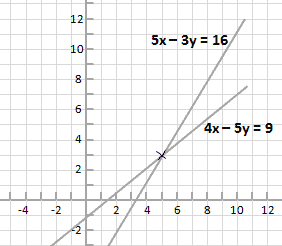
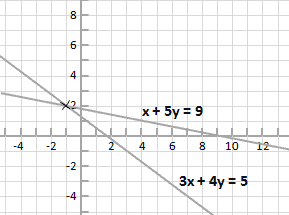
There is one example of each the elimination and substitution methods for solving simultaneous equations shown below.
Elimination Method
Substitution Method
Simultaneous Equations in Real-life
Sam and Jack have 50 dollars between them and Sam has 5 dollars more than Jack. How much money does each have?
s + j = 50
s − j = 5
s = 27.50 , j = 22.50
This example is quite simple, you might be able to work it out by trial-and-error, but you can use any of the methods above to solve it.
And finally,…
Remember to practice with questions from the Simultaneous Equations Worksheet Generator.
Worked examples
Example 1
Elimination. Solve x + y = 7 and x − y = 1.
Solution
Add the equations: 2x = 8, so x = 4. Then 4 + y = 7, so x = 4, y = 3.
Example 2
Substitution. Solve y = 2x and x + y = 9.
Solution
Replace y: x + 2x = 9, so x = 3 and y = 6.
Example 3
Real life. Sam and Jack have 50 dollars between them and Sam has 5 dollars more. How much does each have?
Solution
s + j = 50 and s − j = 5. Adding gives 2s = 55, so s = 27.50 and j = 22.50.
Example 4
No solution. Solve x + y = 2 and x + y = 5.
Solution
The same left side cannot equal 2 and 5. The lines are parallel, so there is no solution.
Common mistakes
- Mistake: Subtracting when the y terms have opposite signs. Fix: If the terms are −2y and +2y, add the equations to eliminate y.
- Mistake: Multiplying only one side of an equation. Fix: When you scale an equation to match coefficients, multiply every term on both sides.
- Mistake: Stopping after finding x. Fix: Substitute x back into one equation to find y, then check both values in the other equation.
- Mistake: Dropping brackets in substitution: 4x − 2(4 − x) written as 4x − 8 − 2x. Fix: −2 × −x = +2x, so it is 4x − 8 + 2x.
Practice generator
Every question is made at random. Get several right in a row to build your streak.
Type your answer and press Check.
Cheat sheet
| Idea | What to remember |
|---|---|
| Solution | the (x, y) that makes both equations true |
| Graphing | the point where the two lines cross |
| Elimination | add or subtract to remove one letter |
| Substitution | rearrange one equation and replace a letter |
| Parallel lines | no solution |
| Same line | infinitely many solutions |
Quick quiz
Check yourself: solving simultaneous equations
5 quick questions. Tap an answer to see if you are right.
The solution of x + y = 4 and 4x − 2y = 10 is:
3 + 1 = 4 and 12 − 2 = 10.
To eliminate y from 2x + 3y = 12 and x − 3y = 3 you should:
+3y and −3y cancel.
If y = x + 2 and x + y = 8, then x =
x + x + 2 = 8.
On a graph, the solution is:
That point lies on both lines.
x + y = 3 and x + y = 7 has:
The lines are parallel.
Answered 0 of 5.
Solving Simultaneous Equations FAQs
What are simultaneous equations?
Simultaneous equations are two or more equations with the same unknowns that are solved together. The solution is the set of values that makes every equation true at the same time.
How do you solve simultaneous equations by elimination?
Multiply one or both equations so that one letter has matching coefficients, then add or subtract the equations to remove it. Solve for the remaining letter and substitute back.
How do you solve simultaneous equations by substitution?
Rearrange one equation to make x or y the subject, such as y = 4 − x, and put that expression into the other equation. Solve it, then find the other value.
What does the graph of simultaneous equations show?
Each linear equation is a straight line. The point where the lines cross gives the solution. For 4x − 2y = 10 and x + y = 4 that point is (3, 1).
Can simultaneous equations have no solution?
Yes. If the lines are parallel they never cross, so there is no solution. If both equations describe the same line, there are infinitely many solutions.
Recommended Worksheets
More practice: Simultaneous Equations Worksheet Generator.


